
The TCM view
Traditional Chinese Medicine describes many pain presentations in terms of obstruction — Qi and Blood not moving freely through a region — and considers what's underneath it, such as cold, deficiency or chronic tension patterns.
Pain care
Does this sound familiar?
The TCM view
Traditional Chinese Medicine describes many pain presentations in terms of obstruction — Qi and Blood not moving freely through a region — and considers what's underneath it, such as cold, deficiency or chronic tension patterns.
The medical view
Research suggests acupuncture influences pain through nervous-system mechanisms, including local tissue effects, spinal signaling and central pain modulation. For chronic pain, effects in trials are typically larger than usual care and modestly larger than sham procedures.
Your care at Seven Medicine
How long care usually takes
Acute issues may respond over a few visits. Chronic pain usually needs a more consistent series — often weekly to start — before evaluating response. We reassess and adjust rather than assume.
01
Treatment addresses the painful area and the broader pattern — sleep, stress and guarding — that keeps pain going.
02
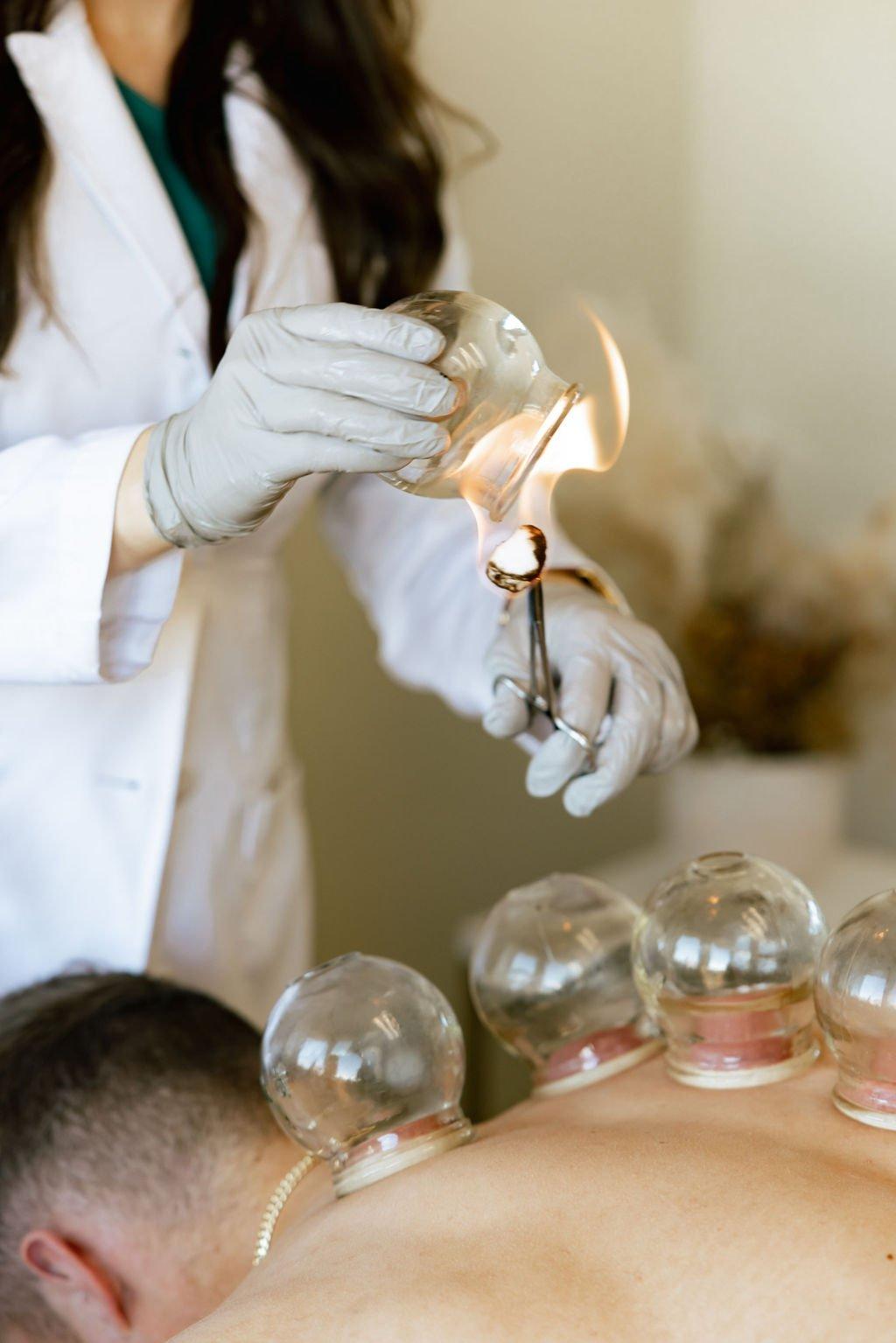
Cupping, gua sha, electro-acupuncture and heat may be added when they suit your presentation.
03
Practical suggestions for rest, movement and ergonomics, coordinated with your physical therapist or physician when you have one.
04
We track pain, function and sleep so you and Dr. Kristina can see what's changing.
Illustrative treatment journey
Treatment response varies. Your care plan is based on your symptoms, assessment and response over time. This is an illustration, not a medical image.
Research
Reviewed October 2026. Research describes groups of people, not guarantees for any individual. Explore the research →
The largest analysis to date pooled individual data from 39 high-quality trials and more than 20,000 patients with back, neck, joint, headache and shoulder pain. Acupuncture outperformed both sham acupuncture and no acupuncture; the advantage over sham was small, the advantage over usual care larger, and benefits largely persisted for up to a year. The authors concluded referral for acupuncture is a reasonable option for chronic pain.
The American College of Physicians' 2017 guideline lists acupuncture among the non-drug treatments to consider first for chronic low back pain. A 2020 Cochrane review found clear benefit versus no treatment, but only a small difference versus sham acupuncture. Expect a reasonable, guideline-endorsed option with modest benefit — not a cure.
In a large UK trial of people with long-standing neck pain, adding acupuncture to usual care modestly reduced pain and disability at 12 months. A 2025 review of 26 trials found acupuncture reduced neck pain and disability more than sham-type treatments, though evidence quality ranged from very low to moderate.
The American College of Rheumatology conditionally recommends acupuncture for knee, hip and hand osteoarthritis — it may help some people. Trials vary: one large 2021 trial found intensive electroacupuncture beat sham, while a 2014 trial found no benefit over sham. Exercise and weight management remain the cornerstones; acupuncture can be an add-on.
A Cochrane review found acupuncture improved pain and stiffness compared with no treatment or standard care, but not compared with sham; benefits faded by six months. A 2025 review reported improvements in pain, fatigue and mood but called for larger, high-quality studies.
From Seven Medicine
Patient story · Acute pain
Acute problems can sometimes need a shorter course of care — and the plan changes when you respond faster.
Individual results vary. These stories describe individual patients and are not typical or guaranteed outcomes.
Patient experiences
Individual experiences vary. Testimonials reflect personal experiences, not typical or guaranteed results.

Meet your practitioner
DAcCHM, M.CM, L.Ac., Dipl. Ac.
Dr. Kristina completed her Doctorate in Acupuncture and Traditional Chinese Herbal Medicine as valedictorian, summa cum laude, after earning master’s degrees in both acupuncture and Traditional Chinese Medicine. Her clinical training spans hospital and rehabilitation settings in Minnesota and clinical study in Zhengzhou, China.
She explains your care in both TCM and familiar medical terms, so you understand what she’s seeing, why she recommends what she does, and how you’ll know if it’s working.
Dr. Kristina holds a clinical doctorate in acupuncture and Chinese herbal medicine. She is a licensed acupuncturist, not a medical physician (MD/DO), and works alongside — not in place of — your medical team.
FAQ
Some people notice a change after one or two visits; longer-standing pain usually takes a series of visits. We track pain, sleep and function so you can see what's changing.
Acute issues may need only a few visits. Chronic pain usually needs consistent care, often weekly to start, with a reassessment about a month in.
Yes, for strains and sprains once serious injury has been ruled out. See a doctor first for significant trauma, numbness or weakness, or pain with fever.
Absolutely. Acupuncture pairs well with physical therapy, chiropractic care and medical pain treatment. Let each provider know what you're doing.
Both use filiform needles. Acupuncture is a complete system of assessment and treatment with extensive training requirements for licensure; dry needling is usually a focused technique for trigger points used by other providers.
Absolutely. Acupuncture pairs well with PT, chiropractic care and medical pain management. Let each provider know what you're doing.
Seek medical evaluation for pain after significant trauma, pain with fever or unexplained weight loss, new numbness or weakness, or loss of bladder or bowel control.
Still have questions?
or call(507) 258-7771